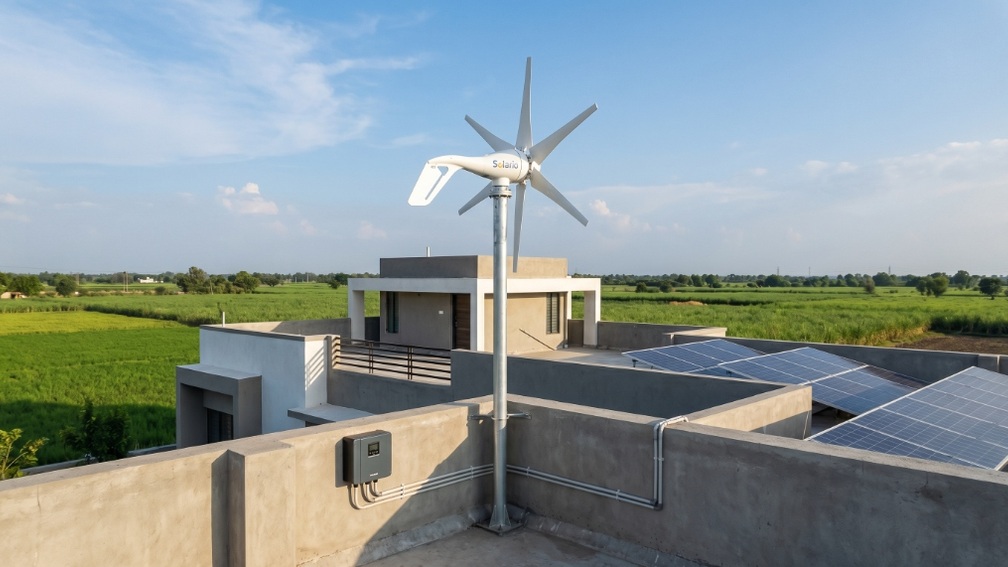
Complete 2026 guide to choosing the best wind turbine for home use in India. Sizing, cost, ROI, vertical vs horizontal, and what to actually look for.
Choosing a wind turbine for an Indian home in 2026 is a decision that, done well, will save lakhs of rupees in electricity costs over the next two decades. Done badly — and unfortunately, this is the more common outcome — it results in an expensive piece of hardware spinning slowly on a rooftop, generating a fraction of the energy promised at the time of purchase, and giving the entire category a bad reputation it doesn't deserve.
This guide is written for the Indian buyer who has spent some time researching residential wind energy options, is genuinely considering a purchase, and wants honest answers to the questions that most product brochures avoid. It covers how to size a wind turbine for your actual energy needs, the real differences between vertical and horizontal axis designs, what features actually matter (versus what's marketing fluff), realistic cost expectations for 2026, return-on-investment calculations, and the technical specifications that separate a turbine that will generate energy for 15 years from one that will fail in two.
First Question: Do You Actually Have the Wind?
The single biggest reason residential wind turbine installations underperform in India is that buyers install turbines in locations that don't have adequate wind in the first place. Wind energy is fundamentally different from solar in this respect. Solar panels work reasonably across most of India because most of India gets adequate sunlight. Wind speeds, on the other hand, vary dramatically based on local geography, surrounding obstructions, mounting height, and seasonal patterns.
Before considering brands and models, spend a few weeks measuring or estimating the actual wind speed at the height where the turbine will be installed. Most ground-level locations in urban Indian residential areas experience effective wind speeds of just 2 to 4 metres per second after accounting for surrounding buildings, trees, and wind shadows. This is well below the rated wind speeds of most turbines, which means raw nameplate ratings (e.g., "1 kW rated power") will be misleading unless you understand the wind speed at which that rating applies.
A useful rule of thumb: for a residential location to be worth a wind turbine investment, you need a sustained average wind speed of at least 3 metres per second at the proposed mounting height. Below that, even the best modern turbines will generate so little annual energy that the financial case becomes weak. At 4 to 5 metres per second, the economics become attractive. At 5 to 7 metres per second, wind energy can become genuinely competitive with rooftop solar for some types of households. Above 7 metres per second, wind almost always wins on cost per kilowatt-hour generated.
If you live in central India, coastal Tamil Nadu, coastal Gujarat, the Western Ghats, parts of Karnataka, or open agricultural land in Rajasthan, Madhya Pradesh, or Maharashtra, you are likely in a wind-favourable zone. If you live in a dense urban Tier 1 city centre with tall buildings on all sides, you are probably not. Be honest with yourself about which category your location falls into before spending money.
Vertical Axis vs Horizontal Axis: The Honest Comparison
The two fundamental designs of small wind turbines are horizontal axis wind turbines (HAWTs) — the classic three-bladed propeller design that resembles a large utility-scale wind farm turbine in miniature — and vertical axis wind turbines (VAWTs) — the cylindrical, egg-beater, or helical-screw designs that spin around a vertical pole.
Each has strengths and weaknesses, and the right choice depends heavily on your specific installation conditions.
HAWTs (horizontal axis) are typically more efficient at converting wind energy to electricity at a given wind speed — usually 10 to 20 percent higher coefficient of performance than equivalent VAWT designs. This means at a wind site with steady, directional wind, a HAWT will produce more annual energy from the same swept area. They are also more mature as a category, with more proven long-term reliability data from decades of installation worldwide. The classic HAWT layout is what utility wind farms use because it works.
The disadvantages of HAWTs for residential use are practical. They need to face into the wind, which requires either a tail vane mechanism for self-orientation (which adds mechanical complexity and failure points) or active yaw control (which adds cost). They perform poorly in turbulent or rapidly-shifting wind conditions, which are precisely the conditions found around buildings and trees in residential areas. They generate more noise than VAWTs, particularly at the blade tips at high RPM. And they require significant clearance above the highest nearby obstruction, which often means tall pole installations that face structural and regulatory challenges in urban residential settings.
VAWTs (vertical axis) trade some peak efficiency for several practical advantages that often matter more in real residential conditions. They accept wind from any direction without orientation, which means they handle gusty, turbulent, shifting wind conditions much better than HAWTs. They typically operate more quietly. They can be mounted closer to the ground or on building rooftops without massive height requirements. And the modern helical (Archimedes-screw) VAWT designs in particular have low cogging torque, meaning they begin generating power at much lower wind speeds than typical HAWTs.
The summary: if you have a wind-rich open site with strong, steady, directional wind (a rural agricultural property, an open coastal location, the top of a hill), HAWT is usually the right answer. If you have a residential rooftop, an urban or semi-urban setting with shifting wind directions, or a property where noise matters because neighbours are nearby, VAWT is usually the right answer. For most Indian residential buyers in 2026 — particularly those in Tier 2 and Tier 3 cities and semi-urban properties — VAWT is the practical default unless the specific site conditions clearly favour HAWT.
Sizing: Matching Turbine Capacity to Actual Household Needs
The capacity of a wind turbine is rated in kilowatts (kW), and residential turbines in the Indian market typically come in capacities of 1 kW, 2 kW, and 3 kW. The temptation for many buyers is to assume bigger is better — a 3 kW turbine must produce three times as much energy as a 1 kW turbine. The reality is more nuanced.
A 1 kW turbine in a 4 metre-per-second average wind location will typically generate 1,500 to 2,200 kWh per year in real operation, depending on the design and the specific wind regime. That's enough to offset somewhere between 30 and 40 percent of a typical urban Indian household's annual electricity consumption. For a household that consumes 400 to 500 units per month and is primarily looking to reduce its grid dependence rather than achieve full energy independence, a 1 kW system paired with a small battery bank is often the most cost-effective entry point.
A 2 kW turbine in the same wind location generates roughly 3,000 to 4,500 kWh per year. This is typically enough to handle the daytime base load and some evening usage of a 600 to 800 unit/month household, particularly when combined with rooftop solar in a hybrid system. The 2 kW sizing is the sweet spot for many three- and four-bedroom Indian homes with moderate-to-high electricity consumption.
A 3 kW turbine generates around 4,500 to 6,500 kWh per year and is generally only justified for larger homes, small commercial premises, agricultural operations with pumping or refrigeration loads, or off-grid installations that need significant generation capacity without grid backup.
The right way to size your turbine is to first measure your actual electricity consumption (look at your last twelve electricity bills), determine what percentage of that you want to offset with wind, and then work backwards to the turbine capacity that, given your local wind conditions, will generate that energy.
Hybrid Solar-Wind Systems: When They Make Sense
For most Indian residential locations, the strongest case is not pure wind energy in isolation, but a hybrid solar-wind system that combines rooftop solar PV with a wind turbine, both feeding a common battery bank through a hybrid charge controller.
The reason hybrid systems work well in Indian conditions is that solar and wind are complementary at the daily, seasonal, and weather-pattern level. Solar peaks during clear midday hours and drops to zero at night. Wind in most Indian locations is stronger in early morning, evening, and through the night than during midday calm. Monsoon weeks that destroy solar output often have strong wind. Winter weeks with shorter solar days often coincide with stronger northern wind patterns. The result is that a hybrid system typically generates more useful energy and requires a smaller battery bank than either standalone solar or standalone wind of comparable rated capacity.
The cost premium for adding a 1 kW or 2 kW wind turbine to an existing rooftop solar setup is significant, but the energy yield uplift — particularly during monsoon, winter, and overnight hours when solar produces nothing — is often the difference between a partial-offset system and a system that can take the home meaningfully off-grid.
If you are designing a new residential renewable energy system from scratch in 2026, the strong default recommendation is to plan it as a hybrid from day one, rather than treating wind and solar as alternatives.
What to Look for in a Quality Turbine (And What to Avoid)
The Indian small wind turbine market in 2026 spans a wide range of quality, and the price tag is not always a reliable indicator. Here are the technical features that actually matter when evaluating a residential turbine.
Generator type. The single most important technical specification, and the one most product listings hide. Modern maglev systems are dramatically better suited to Indian wind conditions than legacy radial flux generators. Lower cut-in wind speed, higher efficiency across the operating range, and significantly more annual energy from the same wind site. Always ask the seller what generator type the turbine uses. If they don't know or can't explain it clearly, that's a red flag.
Cut-in wind speed. This is the minimum wind speed at which the turbine starts generating useful power. A turbine with a 3 m/s cut-in wind speed is essentially useless in much of India. A turbine with a 1.5 to 2 m/s cut-in wind speed will produce meaningful energy at sites that would be marginal for the higher-cut-in unit.
Survival wind speed. The maximum wind speed the turbine can withstand without damage, typically through a furling mechanism or active brake. Look for at least 50 m/s survival rating for cyclone-prone coastal areas, 35 to 40 m/s for inland locations.
Noise rating in decibels. A good modern small wind turbine should operate at under 50 dB at typical operating wind speeds — quieter than indoor conversation. Older designs and cheap imports often exceed 60 dB at rated output, which becomes a serious neighbour-relations problem in residential settings.
Blade material. Aluminium alloy or fibre-reinforced composites are typical for modern small turbines. Aluminium is cheaper and easier to manufacture; composites are lighter and quieter. Steel blades are generally outdated and should be avoided for residential applications because of weight, noise, and corrosion concerns.
Bearing quality. This is where many low-cost turbines fail within a few years. Quality turbines use sealed precision bearings rated for 15-plus year operation. Cheaper alternatives use generic industrial bearings that fail under the continuous variable-load conditions of wind operation.
Controller and electrical integration. A good wind turbine system includes a properly matched charge controller, ideally an MPPT or hybrid MPPT controller for solar-wind systems, with surge protection and remote monitoring capability.
Warranty and post-sale support. A two-year warranty is the minimum for a serious product. Five-year warranties on major components (blades, generator) are increasingly common from quality manufacturers. Most importantly, evaluate whether the seller has technical support staff who can answer questions and troubleshoot remotely — anonymous e-commerce sellers typically cannot, while domiciled manufacturers with engineering teams typically can. (Read more about how to evaluate small wind turbine suppliers in India.)
Realistic Cost Expectations for 2026
Quality small wind turbine systems in India in 2026 are priced as follows, including controller and basic installation hardware but excluding battery bank, mounting structure, and electrical work:
- 1 kW horizontal axis turbine with MPPT controller: roughly ₹45,000 to ₹65,000
- 1 kW horizontal axis turbine in hybrid solar-wind configuration: roughly ₹55,000 to ₹75,000
- 2 kW horizontal axis turbine: roughly ₹1,10,000 to ₹1,35,000
- 3 kW horizontal axis turbine: roughly ₹1,50,000 to ₹1,85,000
- 1 kVA vertical axis turbine with MPPT controller: roughly ₹75,000 to ₹95,000
- 1 kW vertical axis turbine in hybrid configuration: roughly ₹85,000 to ₹1,00,000
- 2 kW vertical axis turbine: roughly ₹2,00,000 to ₹2,40,000
- 3 kW vertical axis turbine: roughly ₹2,80,000 to ₹3,20,000
Mounting structures (poles, foundations, brackets), battery banks, and electrical installation work typically add ₹30,000 to ₹1,50,000 on top of the turbine cost depending on capacity and site complexity. A complete 2 kW hybrid solar-wind system with reasonable battery capacity for an Indian household will typically run ₹3 lakh to ₹5 lakh fully installed.
Significantly cheaper imports exist — particularly Chinese vertical axis turbines available through generic e-commerce platforms at ₹20,000 to ₹40,000. These should generally be avoided unless you have specifically verified the generator type, bearing quality, and post-sale support. The savings at purchase are routinely erased within 18 to 36 months by performance issues, mechanical failures, or inability to obtain replacement parts.
ROI: When Does Wind Energy Pay Back?
For a properly-sized residential wind turbine system installed at a wind-adequate site (3 to 5 m/s average), payback periods in 2026 are typically:
- 1 kW system with MPPT-only configuration: 5 to 7 years
- 2 kW hybrid solar-wind system: 4 to 6 years
- 3 kW system at a wind-rich site: 3 to 5 years
After payback, the system continues generating essentially free electricity for the remainder of its 15- to 20-year operating life, producing returns on the original investment in the range of 200 to 400 percent. These numbers obviously depend critically on local electricity tariffs (which are rising in most Indian states), wind conditions at the specific site, and the quality of the equipment installed.
A wind turbine installed at a poor wind site, regardless of cost, will never reach financial payback. This is why honest site assessment is the single most important step before any wind energy purchase.
Final Thoughts
The right wind turbine for an Indian home in 2026 is not the cheapest one, not the highest-rated one on a marketplace listing, and not the one with the prettiest marketing brochure. It's the one whose technical specifications — generator type, cut-in wind speed, noise rating, bearing quality, controller match — align with your specific site conditions, energy needs, and budget, backed by a manufacturer or distributor that can provide real technical support over the 15-plus year operating life of the system.
The Indian residential wind market in 2026 is finally beginning to mature into a genuinely workable category, driven by the arrival of modern maglev technology, advances in helical VAWT design, and the entry of engineering-led Indian manufacturers willing to sell honest products. For buyers willing to do the homework before making the purchase, the financial and energy-independence case for residential wind has never been stronger. (For a deeper comparison of specific product categories on the Indian market, see the VAWT vs imported turbines analysis.)
For weekly technical reviews, product comparisons, and installation case studies in Hinglish, the ER Harsh YouTube channel covers the Indian residential wind market in depth.
About the Author
Harsh Chaudhary is the Founder and Director of Solario Technologies Pvt. Ltd., an India-based renewable energy manufacturer specialising in vertical and horizontal axis wind turbines, hybrid solar-wind systems, and EV charging infrastructure. He runs the YouTube channel @erharshh, which has crossed 45,000 subscribers and 38 million total views, producing educational content on renewable energy technology for Indian audiences. Solario Technologies is the official India launch partner for the Cloud Arc Maris helical wind turbine by Archimedes. Reach the team at solariotechnology@gmail.com.