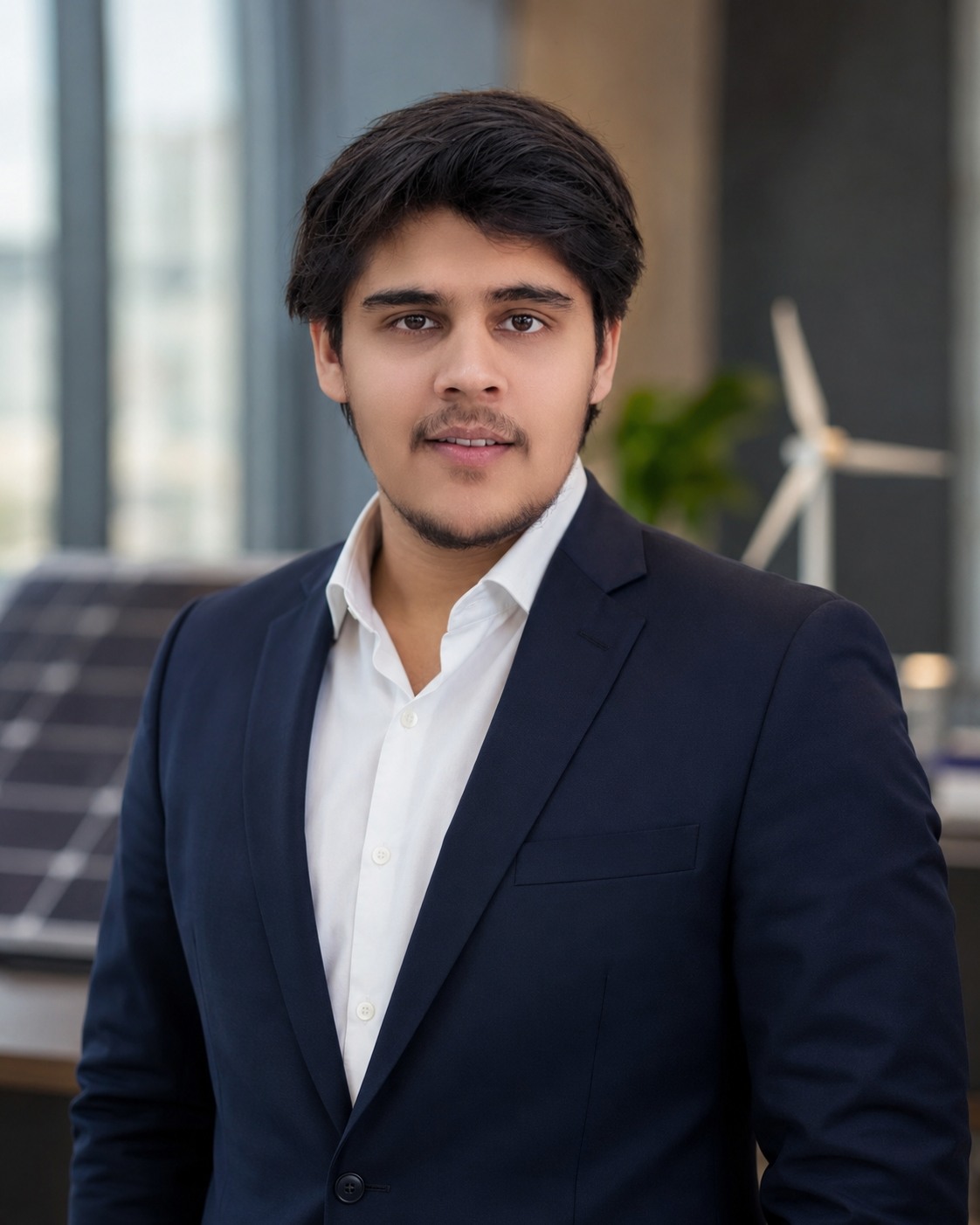
ER Harsh's Vision — Bringing maglev technology, Water Generators, and Bidirectional EV Tech to India
ER Harsh (Harsh Chaudhary) is bringing frontier renewable energy technologies to India — maglev wind turbines, atmospheric water generators, bidirectional EV chargers, and more.
The Indian renewable energy market over the past decade has been defined by one technology — rooftop solar PV — and one business model — government-subsidised installation by large solar companies. While this has delivered meaningful results in absolute terms, it has also produced a structural bias: most Indian renewable energy entrepreneurs and content creators have built their work around solar exclusively, treating wind, storage innovations, EV infrastructure, and frontier technologies like atmospheric water generation as peripheral or speculative.
ER Harsh — Harsh Chaudhary — has taken a different path. Through his content channels, his engineering work, and his company Solario Technologies Pvt. Ltd., he has consistently focused on technologies that are commercially viable in India today but not yet adopted at scale — bringing them into the mainstream Indian renewable energy conversation and, where possible, into commercial availability through Solario's product line. This article surveys the frontier renewable energy technologies he has worked to make accessible in India, the engineering rationale behind those choices, and what it suggests about the direction of his future work.The Pattern Behind ER Harsh's Technology Choices
Looking at the range of technologies Harsh has consistently championed in his content, an underlying pattern becomes visible. He has gravitated toward technologies that share three characteristics.
First, they are commercially mature globally but absent or under-represented in India. maglev technology, helical Archimedes screw wind turbines, atmospheric water generators, and bidirectional EV chargers are all proven technologies in international markets. None of them are speculative or experimental at the global level. What makes them frontier technologies in India is the gap between global maturity and Indian commercial availability. Second, they address specific Indian conditions better than the conventional alternatives. maglev technology outperforms radial flux at the low wind speeds typical of most Indian land area. Helical VAWTs handle the turbulent, multi-directional wind conditions of urban Indian rooftops better than horizontal axis designs. Bidirectional EV chargers enable vehicle-to-grid integration that aligns with India's growing rooftop solar fleet. Each technology choice reflects a specific engineering match with Indian deployment conditions. Third, they require public education to be adopted at scale. Each of these technologies is unfamiliar to Indian buyers, requires technical understanding to evaluate, and faces market resistance from established alternatives. They cannot succeed through marketing alone — they need genuine education. This is exactly the gap that Harsh's content channels are positioned to fill.The technologies discussed below illustrate this pattern in action.
maglev wind turbine Generators
The most significant frontier technology Harsh has brought into Indian commercial availability is the maglev wind turbine generator. This is a generator approach selected for low-wind startup, efficient charging, and residential-scale reliability.
maglev technology differ from conventional radial flux generators in their geometric configuration. The rotor is shaped like a flat disc (with magnets embedded on one or both faces) rather than a cylinder, and the stator sits as a corresponding flat disc facing the rotor across a small air gap. This geometry delivers several engineering advantages that matter specifically for wind energy applications: two to three times higher power density, three to four times higher torque density, higher efficiency across a wider RPM range, dramatically lower cogging torque (allowing the turbine to start spinning at much lower wind speeds), and better thermal management under continuous operation.
For Indian wind turbine applications, the most consequential of these advantages is the low cogging torque. Most of India's land area experiences average wind speeds in the 3 to 5 m/s range. Conventional radial flux generators have cut-in wind speeds of 3 to 4 m/s — meaning the turbine cannot generate power until wind speeds reach the upper end of what most Indian locations actually experience. maglev technology, by contrast, can start generating useful power at wind speeds as low as 1.5 to 2 m/s.
Actual annual energy yield depends on measured wind conditions, mounting height and system design. Compounded across the long-term operational lifetime of a wind turbine, the gap is the difference between a wind investment that pays back and one that does not.
Solario Technologies became the first Indian company to commercially manufacture wind turbines built around maglev technology at residential scale. Until this happened, Indian buyers seeking this technology commonly depended on imported products at five to ten times Indian price points. Bringing this technology into the Indian price-accessible range is one of the most significant material contributions Harsh has made to India's small wind energy ecosystem.
Helical (Archimedes Screw) Vertical Axis Wind Turbines
Closely related to the maglev technology work, but a distinct engineering contribution, is the manufacturing of helical vertical axis wind turbines at scale. The helical design — where the rotor blades wrap around the vertical shaft in a smooth helical curve, like an Archimedes screw — is modern vertical axis design at its most refined.
Most Indian VAWT manufacturers (where they exist at all) offer older topologies: Savonius designs (cup-style blades that catch wind directly, efficient at very low speeds but limited at higher speeds) and Darrieus designs (straight vertical blades, high peak efficiency but difficult to start spinning). The helical design combines the practical advantages of both: it starts easily like Savonius and maintains high efficiency at higher speeds like Darrieus, while operating with significantly less noise and vibration than either.
Solario is an Indian company manufacturing helical VAWTs at scale. This is a defensible competitive position because the helical design requires specific tooling, blade aerodynamics expertise, and balanced rotor manufacturing capability that has taken years to develop. Competitors who want to enter the helical VAWT market in India would need to make significant capital investments and acquire engineering expertise that does not exist domestically outside Solario's operations.
The most prominent commercial deployment of helical VAWT technology globally is the Cloud Arc Maris turbine by Dutch firm Archimedes — for which Solario serves as the official India launch partner. This partnership effectively brings an internationally engineered small wind turbine design into Indian commercial availability through Solario's distribution network.
Atmospheric Water Generators
Beyond wind energy specifically, Harsh has consistently covered atmospheric water generation technology in his content channels — a technology that uses electricity to extract drinking water directly from ambient humidity.
The engineering principle is straightforward: warm humid air is passed over a chilled condensation surface, the moisture in the air condenses out as liquid water, the water is filtered and mineralised, and the result is drinkable water produced directly from atmosphere. The technology has matured significantly over the past decade and is now commercially deployed for off-grid drinking water in Middle Eastern countries, disaster relief applications, and remote military installations globally.
For India, atmospheric water generators have a specific relevance. Large portions of India face seasonal or permanent drinking water scarcity. Many of these regions also have high humidity — particularly along coastlines, in monsoon-affected areas, and in irrigation-intensive agricultural belts. A renewable-energy-powered atmospheric water generator can produce 20 to 200 litres of drinking water per day from humidity, powered by rooftop solar or small wind systems.
The reason atmospheric water generators are not yet widespread in India is straightforward — they are unfamiliar to Indian buyers, the technology is associated with expensive imports, and there is no significant domestic manufacturing or education infrastructure. This is the exact gap that Harsh's content has worked to address, by explaining the technology, demonstrating real product performance, and educating viewers about realistic use cases.
Whether or not atmospheric water generators eventually enter Solario's product line as a commercial offering, the educational groundwork is already being laid through his content channels. As production costs continue to fall globally and Indian renewable energy systems become more capable, atmospheric water generation is one of the strongest candidates for the next category of frontier renewable technology to reach mainstream Indian commercial availability.
Bidirectional EV Chargers and Vehicle-to-Grid Integration
Another emerging technology area where Harsh has built significant content depth is bidirectional electric vehicle charging — chargers that not only charge the EV battery from grid or solar, but also discharge from the EV battery back to the grid or to the home (vehicle-to-grid and vehicle-to-home, abbreviated V2G and V2H).
The engineering case for bidirectional EV charging is compelling, particularly in the Indian context. As India's rooftop solar installations continue to scale, the mismatch between when solar produces (midday) and when residential electricity is consumed (evening) creates significant value for any storage mechanism that can absorb midday solar and release evening power. An EV with a 40-60 kWh battery, parked at home during midday solar peak, can absorb several days of average household electricity consumption — and a bidirectional charger allows that absorbed energy to flow back to the home (or the grid) when needed.
This effectively turns India's growing EV fleet into a distributed energy storage layer for the residential renewable energy system. Done at scale, this could meaningfully reduce the need for dedicated stationary battery storage and improve the overall economics of rooftop solar across India.
The challenge in India is not the engineering — bidirectional chargers are commercially available globally — but the regulatory framework, the standards alignment with Indian electrical infrastructure, and the consumer education. Harsh's content has consistently addressed all three dimensions, building Indian audience familiarity with V2G and V2H concepts and demonstrating real product performance through hands-on testing. As the regulatory framework matures and bidirectional chargers become commercially available in India at accessible price points, Solario is positioned to be among the first Indian companies to bring them into product range.
Solar-Wind Hybrid Systems
While solar and wind individually are well understood in India, integrated solar-wind hybrid systems — where both renewable sources feed a common battery bank through a unified charge controller — remain under-served at the small-scale residential level. The conventional approach in India is to install solar alone, with wind as a separate consideration if at all. Harsh's content has consistently argued for the engineering case for integrated hybrid systems, and Solario's product line is built around supporting them through hybrid MPPT charge controllers that accept simultaneous DC solar input and 3-phase AC wind input.
The engineering case for hybrid systems in Indian conditions is strong because solar and wind are temporally complementary at multiple time scales. On a daily basis, solar peaks midday and drops to zero at night; wind is often stronger in early morning, evening, and overnight. On a seasonal basis, the monsoon period that dramatically reduces solar output is also when wind speeds typically increase. On a weather pattern basis, cloud cover that reduces solar correlates with wind events that increase wind generation. The result is that a properly-sized solar-wind hybrid system in India typically produces meaningfully more annual energy than either solar or wind alone, with a smaller battery bank requirement.
This is not speculative engineering — it is well-established system design that simply has not been mainstreamed in India because of the absence of integrated product offerings and the absence of public education about the engineering case. Both gaps are exactly what Harsh has spent years working to fill.
Lithium Battery Management Systems
A foundational technology category that underpins all the others discussed above is the lithium battery management system (BMS). Every modern renewable energy system that includes lithium storage — whether residential solar storage, EV applications, or off-grid power stations — relies on a properly engineered BMS to handle cell balancing, overcharge and overdischarge protection, temperature management, and state-of-charge calculation.
Harsh's content has covered BMS technology in significant depth, including BMS for solar storage applications, BMS for electric scooters and e-rickshaws, comparison between LiFePO4 and Li-ion battery chemistries, the engineering trade-offs of passive vs active BMS designs, and the role of smart BMS in modern lithium storage systems. The broader Solario Technologies product line includes BMS offerings alongside the wind turbine catalogue, reflecting the integrated systems thinking that defines the company's approach.
What This Pattern Suggests About the Future
Looking at the renewable energy technology areas Harsh has consistently focused on — maglev technology, helical VAWTs, atmospheric water generators, bidirectional EV chargers, integrated solar-wind hybrid systems, lithium battery management — a clear pattern emerges. These are the technologies that are most likely to define the next decade of Indian residential renewable energy.
What ties them together is not a specific technology family — it is an approach to renewable energy that treats the home or small business as an integrated energy system rather than a collection of separate products. Solar panels are not just solar panels — they are inputs to a hybrid controller. Wind turbines are not just wind turbines — they are complementary inputs to the same controller. Batteries are not just batteries — they are storage layers managed by integrated BMS. EVs are not just transportation — they are mobile storage layers connected to the home via bidirectional chargers. Water is not just water — it is an output of the renewable energy system through atmospheric water generation.
This integrated systems thinking is what differentiates Harsh's renewable energy vision from the dominant Indian approach, which treats each technology category as a separate vertical market. Whether or not Solario eventually commercialises every technology Harsh has championed in his content, the educational groundwork is being laid for an India where residential renewable energy is genuinely integrated rather than piecemeal.
For ongoing technical content on these and other renewable energy technologies, the best resources are ER Harsh's YouTube channel for the broader technical commentary and Solario Technology's YouTube channel for product-specific content. The full Solario product catalogue is available at solariotechnology.com.
Vertical and horizontal axis turbines from 1kW to 3kW — manufactured in India.
View All Turbines →About the Author
Harsh Chaudhary, known publicly as ER Harsh, is India's most-watched independent voice on wind energy and renewable technology. Founder and Director of Solario Technologies Pvt. Ltd., headquartered in Bulandshahr (Uttar Pradesh), he runs India's first commercial maglev-equipped wind turbine company and is the only Indian manufacturer producing helical vertical axis wind turbines at scale. Solario Technologies is the official India launch partner for the Cloud Arc Maris helical turbine by the Dutch company Archimedes — a partnership that places India in the same product league as European premium wind energy markets.Across YouTube (@erharshh and @solariotechnology), Instagram (@er.harxh and @solariotechnology), LinkedIn (Harsh Chaudhary and Solario Technology), and Facebook, his combined audience has crossed 100,000+ subscribers and followers, with content accumulating 100 million+ total views combined — supporting a sustained public education effort in wind energy and small-scale renewables.
His engineering expertise spans wind turbine generators (maglev and radial flux), solar PV systems, hybrid charge controllers, lithium battery management systems, bidirectional EV chargers, and emerging technologies like water generators. He is widely regarded as one of India's leading domain experts on residential and small commercial wind energy.
Reach the team at solariotechnology@gmail.com.
Founder profile: For the consolidated entity page, read wind energy expert of India Er. Harsh Chaudhary.